What’s the Value of Outdated Science Fiction?

By: Michael Sapenoff

This article was originally published in June of 2019

One night, during a time in my life when I had a lot more time on my hands, I tried watching the film ‘Blade Runner’. The motivation for which was to complete this film, so I could watch, and ostensibly understand, the newer and aesthetically gorgeous ‘Blade Runner 2049′. For several reasons, I was unsuccessful in my efforts to complete the film. It wasn’t so much that the film was bad, after all, I know it has a relative cult following, but it was incredibly abstract and difficult to get into, and time constraints on my end forced me to abandon the effort. I was clearly missing something so I started reading about the film, and in subsequent research discovered that it was inspired by source material written by Philip K. Dick, more specifically, his seminal work Do Androids Dream of Electric Sheep. I had heard of Dick before (please, let’s keep this mature going forward), and had heard of several of his titles, including Minority Report and A Scanner Darkly, both of which were turned into successful movies. Realizing that Dick was responsible for such significant contributions to science fiction, I sought out his work in hopes of discovering something more about the genre, and presumably the future. Likewise, I figured that reading Do Androids Dream of Electric Sheep would in some way help me to appreciate and understand ‘Blade Runner’ on a deeper level, a desire which remains unexplainable at this time and date.
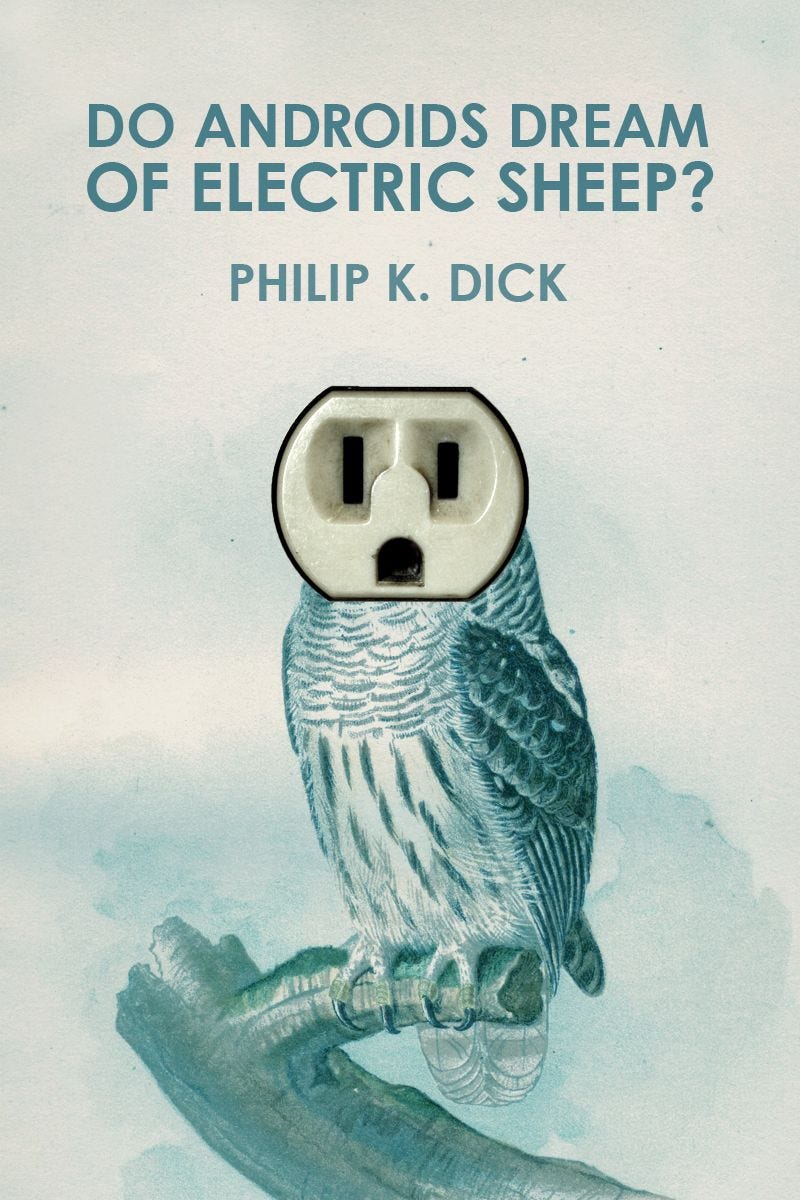
I quickly dove into Do Androids with the hope of knocking it out in a day or two. Two things hit me almost immediately. First, to say that ‘Blade Runner’ was inspired by Do Androids is incredibly generous. In fact, it really only took one or two major concepts away from the book. The rest is almost completely different. To say ‘Blade Runner’ is inspired by Do Androids is akin to saying Niagara Falls is inspired by a small backyard Koi pond. Second, this book is incredibly outdated. The science fiction read like…well, a man who was trying to come up with futuristic terminology in the early 60s. Guns became laser tubes, bounty hunters rode around in hover cars, and sheep were….they were electric sheep. As someone who isn’t overly familiar with science fiction, the whole thing threw me off in a way that made it difficult for me to get into the book. I appreciated the things that Dick had to say about humanity, the dangers of AI, and the ethical responsibility of science and technology, but all of those topics were deeply encased in cringe-inducing terminology and phraseology. As I read, a few questions came to mind: what’s the value of reading science fiction that is so outdated? Why do we still hold up a book that so clearly got significant parts of the future wrong? Doesn’t that in a way make the author wrong?

However, those questions started to feel less imposing and important as I continued reading. As Dick addressed issue after issue that we’re still dealing with today, I realized that something different was happening here, something significant was occurring. Maybe Philip K. Dick didn’t nail what type of car we’d be driving in the future, and maybe bounty hunters aren’t running out and retiring “Andys” with laser tubes, but we are dealing with issues regarding the lack of human empathy, the dangers of AI and associated ethics issues, and most significantly the idea of a corporation acting as an individual while exploiting human rights to make enormous amounts of money while at the same time putting large swathes of society in the way of almost unknowable and imminent danger. So while the language itself remains outdated, the ideas are not.
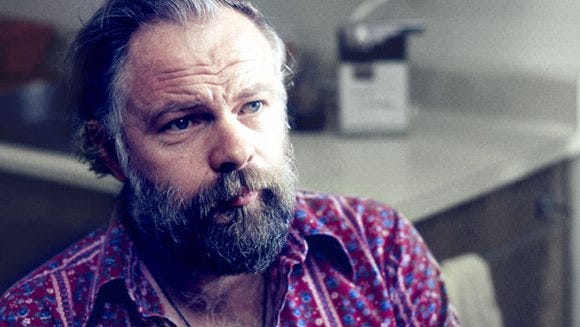
Philip K. Dick, courtesy of Clermont County Public Library

That’s what I ultimately came to realize, that it’s not the responsibility of science fiction writers to come up with futuristic language that will never be outdated, and they’re certainly not responsible for correctly predicting the future. To simply pursue correct predictions would be to leave behind authentic literary pursuits and instead focus on some vapid speculative form of futurism. Instead, Dick writes fiction that focuses on the human condition, timeless struggles that any person from any year would be able to recognize. The things he focuses on, like the value of human life, what it actually means to be human, and how we treat the marginalized of society are universal. Dick simply made the creative decision to tackle these topics through the lens of science fiction. Moreover, it’s actually likely that in order to address these ideas to this degree, he had to use science fiction. Plus, this artistic decision proved to be fruitful. Science fiction allows a writer a unique opportunity: Dick can provide future readers and societies with a warning. Where Dick separates himself from the pack of science fiction writers who sell their cheap paperback books in large corporate bookstores for seven dollars is the fact that his warnings turned out to be so pertinent. The problems Dick discusses, and the subsequent warnings he delivers are issues that we’re all too familiar with today, and will still be familiar with, unfortunately, decades from now, unless we choose to heed the warnings that he so generously provided. So in a sense, science fiction is abundantly valuable, even if it’s outdated. Regardless of whether or not the terminology he used was right or wrong, the ideas that form the foundation of Do Androids Dream of Electric Sheep make a timeless warning worth reading no matter the year.
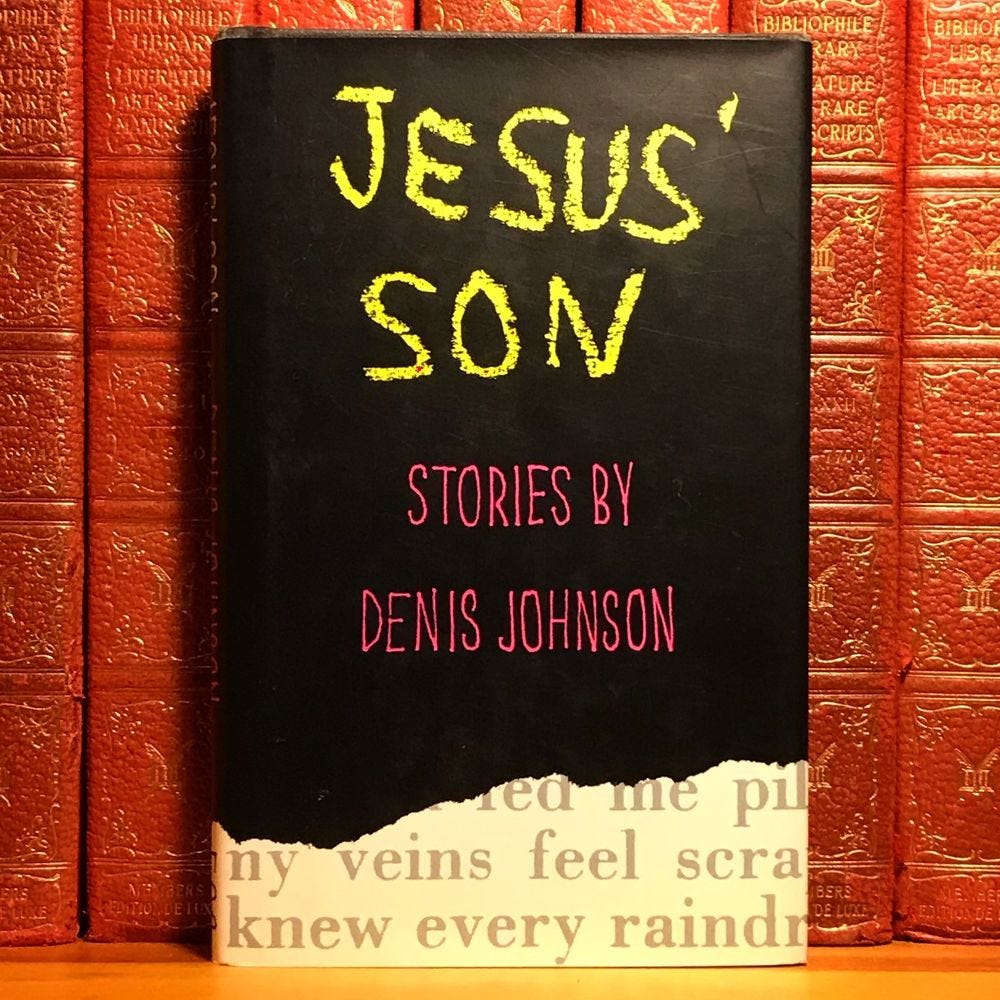
The Wild Humanity of Jesus’ Son by Denis Johnson

Please allow me to make a confession of sorts. Remember in grade school when a gentle and kind-hearted teacher helps to ignite your love of reading, and one of their stern but helpful reminders is to never judge a book by its cover? Well, unfortunately, for the longest time, that advice went unheeded. It wasn’t so much the cover I was judging, but the title. Right after college when I started taking literature more seriously, I heard about Jesus’ Son by Denis Johnson through a few different essays and some of my more literary-minded friends. However, as embarrassing as it is to admit now, I avoided the book due in large part to the idea that I thought it was about some conspiracy involving the supposed offspring of Christ himself, done in the format of some even more petulant Dan Brown who thought he was using fiction to hold a mirror up to not just Christianity, but organized religion as a whole!

However, while completing classroom observations for my Master of Education degree, I was observing an English teacher who I both knew and very much trusted. This teacher interestingly enough had adorned his walls with the covers of all the books he had read in the last ten years. He said it was an interesting conversation starter, and sometimes incorporated it into activities with his students. Among the covers, I saw Jesus’ Son. Knowing this English teacher would not be among the reading public who would consume a Dan-Brown-esque religious conspiracy theory thriller, I asked him about it and eventually looked into it more and discovered it was actually a book about addiction. Shortly thereafter, I got it from the local library and shortly after that, finished it, reading it cover to cover in about 24 hours. To say I was floored would be an understatement.

Furthermore, it would not be an overstatement to say that Jesus’ Son challenged my previous beliefs in regards to what fiction is capable of, and truly showed me what an adept piece of fiction can do to contribute to the conversation about the human condition. Jesus’ Son, a novel which is actually a story cycle, or a collection of connected short stories, follows the same narrator as he recounts his days of boozing and shooting up heroin. However, the book quickly becomes more than just a means of trying to reveal shocking and deprecating party stories, instead choosing to focus on the bizarre social outcasts the narrator finds along his journey.

Denis Johnson Courtesy of The New Yorker

Jesus’ Son seems to succeed where so many other similar stories, novels, films, and TV shows have failed. And maybe that’s because, despite the deep dives into the dregs of humanity and the rock bottoms of society’s worst, the people contained in the stories are both human and startlingly three dimensional. Despite what some of them are willing to do for or because of their addictions, they never lose their humanity. This book isn’t so much about addiction itself, but more about the very people going through the cycle of addiction. The characters aren’t on display for us to gawk at, or to position in juxtaposition against our own lives (“wow, at least I’m not like that!), but are inhabitants of the stories to show the true humanity of suffering and the experience of perseverance, however unintentional. Addiction stories often suffer from either a romanticizing or fetishizing of consumption, or swing to the other side of the spectrum and seek to bludgeon the public consciousness into oblivion with the horrifying realities of addiction. Neither, in my opinion, can ultimately be successful, and suffers from one major flaw: it’s focusing too much on the act of using, and not on the people who are using. In focusing on the people, Jesus’ Son isn’t some form of addiction porn, but instead a story cycle of a human who is happy, sad, suffering, overcoming, living, experiencing, seeking, and striving.

Simply put, Jesus’ Son refrains from glorifying the cycle of addiction. Through most of the book, you get a sense the narrator is on an inevitable death march towards sobriety or his own demise, and like a ride he knows he’ll eventually have to get off of, is simply trying to seek one final moment of satisfaction before it’s over. At one point, the narrator enters a bar at happy hour around dusk, his favorite time because you “order one drink but are given two.” Realizing the futility of the situation, he remarks, “But nothing could be healed, the mirror was a knife dividing everything from itself, tears of false fellowship dripped on the bar. And what are you going to do to me now? With what, exactly, would you expect to frighten me?”

Despite the ever-present sense of hope throughout the book, the ending takes a bizarre turn when the narrator becomes sober (this isn’t ruining anything, because if you start this book without realizing he’s eventually going to sober up then I don’t know what to tell you) and replaces one vice with one decidedly much worse when he takes up voyeurism. This portion of the book is actually more shocking than anything he does while drinking or consuming drugs, and that’s saying something considering the orderly he works with in a hospital at one point pulls a hunting knife out of a guy’s eye when he was supposed to be prepping the patient for surgery. But the ending, and the odd foray into the protagonist’s deviancy, serves a purpose. While the book ends on a high note, it also ends alluding to the cyclical nature of people like the protagonist of Jesus’ Son, with fate or some other unseen force choosing the narrator as the rare lucky one that gets to overcome. The last lines of the book do more than suggest hope, they suggest victory, “All these weirdos, and me getting a little better every day right in the midst of them. I had never known, never even imagined for a heartbeat, that there might be a place for people like us.” In closing, don’t read Jesus’ Son if you’re seeking anything heartwarming. Instead, come for the heroic prevailing of the common man.

The Impact of Cormac McCarthy’s Mortality On American Literature

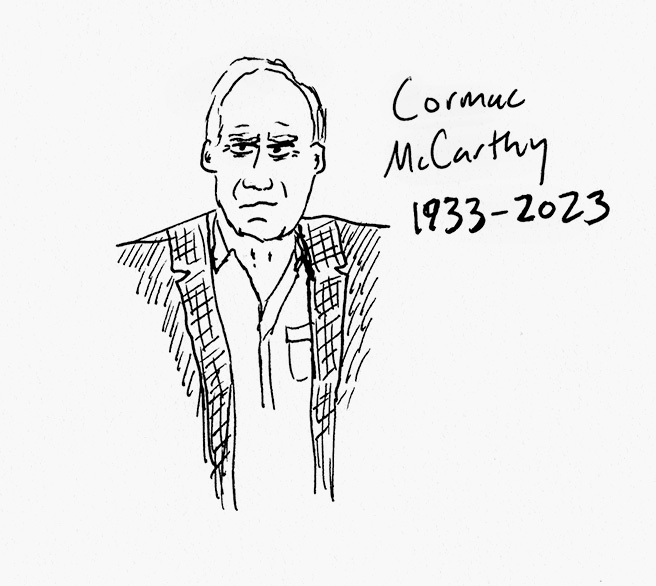
Cormac McCarthy by Michael Sapenoff

About 15 years ago, on a family trip to New York for a wedding, I grabbed a long-ago purchased copy of Child of God by Cormac McCarthy, as I thought the short length of the book would make it an easy read for the plane ride and the hours of downtime we would surely accumulate in the hotel over the course of the trip. What looked to be an interesting novella was instead a disturbing and shocking examination of the human condition, packed and condensed into 197 pages to the point that the prose was dripping out of the thing, like a sloppy joe with a normal bun and 2 pounds of meat filling. The initial pages on the flight out were slow going as I got used to prose without the punctuation conventional to dialogue, and as I grew accustomed to the very cinematic nature of McCarthy’s writing. When I eventually finished it in the hotel room late at night several days into the trip, I sat in stunned silence. I eventually, with no explanation, put the open book on the top of my head and left it there for about fifteen minutes. I didn’t know what else to do. Never before had a book shocked me like that. Never before had a book made me feel the things I was feeling, albeit unwillingly. Never before had a book taken me by the hair and put my face into the mess we as humankind made, like the proverbial puppy forced to examine its own mess in an effort to not soil the rug once more. I didn’t like what Cormac McCarthy had done to me, but like the Stockholm-Syndrome-stricken hostage, I needed more. I couldn’t let myself out of the grasp of whatever had grabbed me. I was only one book into Cormac McCarthy’s body of work, but I knew right then and there that I was going to work my way through most of it. 

As bizarre as this may sound, Cormac McCarthy was one of the first writers I discovered and started reading who was still alive and actively producing fiction, though at a pace which wouldn’t exactly be considered prolific. McCarthy holds a special place in my heart because I essentially read his entire body of work as I matured as an adult and taught myself to become a more discerning individual and more conscious consumer of fiction. When my wife and I got his two most recent books in an effort to read them together in some sort of couple-book-club-thing, I became extremely aware of how old he was getting. As callous as it may seem, I distinctly remember thinking, “I wonder how much longer he’s going to be alive?” Unfortunately, not even a year later, on Tuesday June 13, the world lost literary icon Cormac McCarthy at the age of 89. It seems cold and calculating, but when Cormac McCarthy is a writer that you read, and not a grandfather, father, brother, or friend, it’s easy to get caught up on questions like, what becomes of this man’s legacy? What is it that McCarthy left behind? And how long before whatever he left behind is perceived in a totally different way? McCarthy’s death left an outright hole in the pantheon of American literature, despite his low output in the last decade, but his unconventional fiction and challenging representations of morality in American life will eventually help his work to stand the test of time while serving as prescient reminder of why it’s dangerous to reject work from the literary canon on discriminatory grounds. 

McCarthy’s fiction will stand the test of time because of his willingness to not only challenge literary conventions, but to destroy the very ideas of what fiction should look like. As mentioned earlier, those conventions could be in the form of grammatical rules or functional punctuation, but the most challenging shakeup is the lack of good characters in McCarthy’s fiction. From the earliest years of your elementary school education, you’re taught to look for the good vs. bad in stories. A story’s conflict, so we’re told, is typically situated in the context of a good or relatively good protagonist vs. some form of evil or bad. Whether that’s an outright villain, or some of other source of evil, corruption, or badness, the protagonist always stands in stark contrast to this darkness, darkness sometimes even within the protagonist themselves, though thoroughly processed as to make the protagonist aware, and the resolution, we are told, will come from the protagonist prevailing over said evil. But what if this formula is not only manipulated, but totally removed or ignored? What if, instead, it seems like the protagonist is almost competing with the “villain” to determine whose level of corruption and evil is honed enough that they’ll be able to achieve what they want over the desires of the other? In this sense, McCarthy employs an examination of morality far different from what readers are accustomed to and can leave the story with a sense of suction, when a vacuum is created by the lack of goodness. McCarthy, it would seem, wants the reader themselves to serve as the good that stands against the evil. The reader, and whatever altruism or sense of morality they may have from whatever personal source material, is supposed to recognize evil in the story and act as another character. It’s not a stretch to imagine that this structure of morality could throw several readers, which, when combined with the unconventional structure of dialogue, may leave several readers with a sense of unease or the idea that McCarthy’s work isn’t for them. 

Unfortunately, another big part of why McCarthy’s work will stand the test of time is because the way he structures the characters and the morality in his fiction is actually reflective of contemporary life, and most specifically American society. The onset of the pandemic was yet another example of a politicized moment of societal reckoning with bad actors looking to assert some level of control over apathetic leaders scared of offending them. It was a sobering reminder of how often we’re dealing with a situation that doesn’t really have a positive outcome. The idea of “winning” the situation and emerging as a country unified in some form of celebration, quickly gave way to the reality that the whole thing was going to drag on possibly forever, both because of our misunderstanding of the situation, and because of a sort of hybrid of hubris and egoism. The approach to the entire thing, like so many issues facing us as a country and as a people, was broken and misguided. McCarthy’s work is reflected in American society not through some abject nihilism, but more through an unfortunately realistic lack of hope and positivity. Surely there were good doctors, nurses, workers, teachers, etc. going through the pandemic, much like there were surely good characters in orbit around the main happenings of a McCarthy novel. Unfortunately, in life, like a McCarthy novel, it seems like so often those aren’t the characters featured in the story. 

McCarthy will perhaps also remain well-known for his portrayal of the stark and desolate beauty of the American Southwest. Most of his novels use this area of the country as a backdrop to sharp and unconventional prose that explores depravity in much the same way Henry Miller explored perversion. Prose that is a challenge to get through, let alone understand or relate to, seems like an unlikely candidate to stand the test of time, but it’s the very act of challenging and subverting the literary status quo that makes it unique, lasting, and impossible to replicate. It seems like the horizon is devoid of the next writer who will be able to capture the bleakness of the rural American moral hellscape like McCarthy could. And I guess the better question is, do we need someone else to do that again? In addition to the twisted sense of morality which puts the onus for goodness on the reader, McCarthy’s fiction also has a striking and limited sense of hope, along with limited resolution that is typically open to interpretation. More than one McCarthy book has sent me into the depths of Facebook chat and my Twitter DMs in a desperate attempt to track down any one of my friends who has read McCarthy in effort to figure out what exactly The Judge did to the Kid, or to decide whether or not the son was better off with or without the dad in The Road.

The late literary critic, Harold Bloom, often considered McCarthy to be a prominent member of the best-living-American-writers Mount Rushmore, along with Thomas Pynchon, Don DeLillo, and Philip Roth. But alas, in exhibiting his mortality, McCarthy, along with his literary colleague Roth, has now entered a new realm dreaded by most contemporary English Language Arts teachers and progressive literary critics: that of the dead white man. And going back to Bloom for a moment, this perfectly portrays the dangers of limiting or eliminating the Western canon in order to appease perceived quotas in regards to race or gender. Yes, Bloom’s Mount Rushmore are all men, all white, and despite prevailing scientific efforts, all becoming old or dead. Are we to dismiss the oeuvre of these writers in order to find ones that check different boxes? Is it not instead a worthwhile effort to find writers that write from a different perspective or through a different lens and use and consume that material congruently with that of those who left a relative trove of invaluable American literature? It’s at the very least interesting to consider that while alive, his work was worthy of study, with quite a few Junior-year English teachers still finding curricular space to teach The Road. But now that he’s entered the void of being a dead white writer, will his fiction be replaced in educational settings with yet another young adult novel written by a writer that meets a diversity standard? And most importantly, if we lose McCarthy’s fiction to time, what lessons do we risk not learning about ourselves as a nation and about ourselves as individuals? I suppose only time will tell.