
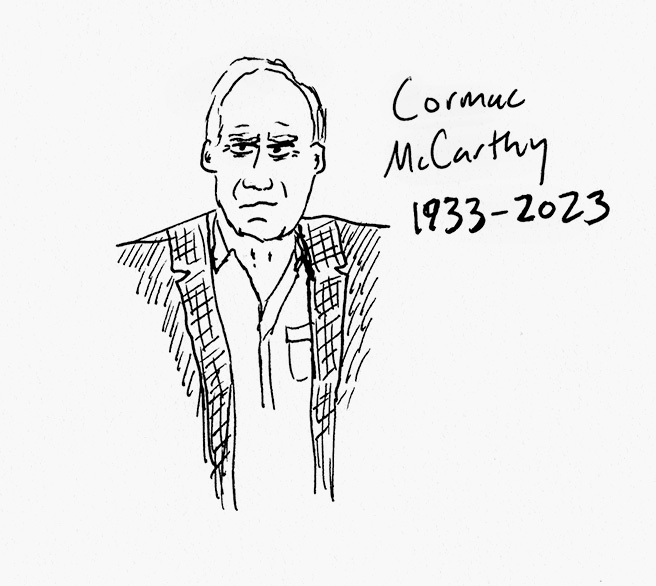
About 15 years ago, on a family trip to New York for a wedding, I grabbed a long-ago purchased copy of Child of God by Cormac McCarthy, as I thought the short length of the book would make it an easy read for the plane ride and the hours of downtime we would surely accumulate in the hotel over the course of the trip. What looked to be an interesting novella was instead a disturbing and shocking examination of the human condition, packed and condensed into 197 pages to the point that the prose was dripping out of the thing, like a sloppy joe with a normal bun and 2 pounds of meat filling. The initial pages on the flight out were slow going as I got used to prose without the punctuation conventional to dialogue, and as I grew accustomed to the very cinematic nature of McCarthy’s writing. When I eventually finished it in the hotel room late at night several days into the trip, I sat in stunned silence. I eventually, with no explanation, put the open book on the top of my head and left it there for about fifteen minutes. I didn’t know what else to do. Never before had a book shocked me like that. Never before had a book made me feel the things I was feeling, albeit unwillingly. Never before had a book taken me by the hair and put my face into the mess we as humankind made, like the proverbial puppy forced to examine its own mess in an effort to not soil the rug once more. I didn’t like what Cormac McCarthy had done to me, but like the Stockholm-Syndrome-stricken hostage, I needed more. I couldn’t let myself out of the grasp of whatever had grabbed me. I was only one book into Cormac McCarthy’s body of work, but I knew right then and there that I was going to work my way through most of it.
As bizarre as this may sound, Cormac McCarthy was one of the first writers I discovered and started reading who was still alive and actively producing fiction, though at a pace which wouldn’t exactly be considered prolific. McCarthy holds a special place in my heart because I essentially read his entire body of work as I matured as an adult and taught myself to become a more discerning individual and more conscious consumer of fiction. When my wife and I got his two most recent books in an effort to read them together in some sort of couple-book-club-thing, I became extremely aware of how old he was getting. As callous as it may seem, I distinctly remember thinking, “I wonder how much longer he’s going to be alive?” Unfortunately, not even a year later, on Tuesday June 13, the world lost literary icon Cormac McCarthy at the age of 89. It seems cold and calculating, but when Cormac McCarthy is a writer that you read, and not a grandfather, father, brother, or friend, it’s easy to get caught up on questions like, what becomes of this man’s legacy? What is it that McCarthy left behind? And how long before whatever he left behind is perceived in a totally different way? McCarthy’s death left an outright hole in the pantheon of American literature, despite his low output in the last decade, but his unconventional fiction and challenging representations of morality in American life will eventually help his work to stand the test of time while serving as prescient reminder of why it’s dangerous to reject work from the literary canon on discriminatory grounds.
McCarthy’s fiction will stand the test of time because of his willingness to not only challenge literary conventions, but to destroy the very ideas of what fiction should look like. As mentioned earlier, those conventions could be in the form of grammatical rules or functional punctuation, but the most challenging shakeup is the lack of good characters in McCarthy’s fiction. From the earliest years of your elementary school education, you’re taught to look for the good vs. bad in stories. A story’s conflict, so we’re told, is typically situated in the context of a good or relatively good protagonist vs. some form of evil or bad. Whether that’s an outright villain, or some of other source of evil, corruption, or badness, the protagonist always stands in stark contrast to this darkness, darkness sometimes even within the protagonist themselves, though thoroughly processed as to make the protagonist aware, and the resolution, we are told, will come from the protagonist prevailing over said evil. But what if this formula is not only manipulated, but totally removed or ignored? What if, instead, it seems like the protagonist is almost competing with the “villain” to determine whose level of corruption and evil is honed enough that they’ll be able to achieve what they want over the desires of the other? In this sense, McCarthy employs an examination of morality far different from what readers are accustomed to and can leave the story with a sense of suction, when a vacuum is created by the lack of goodness. McCarthy, it would seem, wants the reader themselves to serve as the good that stands against the evil. The reader, and whatever altruism or sense of morality they may have from whatever personal source material, is supposed to recognize evil in the story and act as another character. It’s not a stretch to imagine that this structure of morality could throw several readers, which, when combined with the unconventional structure of dialogue, may leave several readers with a sense of unease or the idea that McCarthy’s work isn’t for them.
Unfortunately, another big part of why McCarthy’s work will stand the test of time is because the way he structures the characters and the morality in his fiction is actually reflective of contemporary life, and most specifically American society. The onset of the pandemic was yet another example of a politicized moment of societal reckoning with bad actors looking to assert some level of control over apathetic leaders scared of offending them. It was a sobering reminder of how often we’re dealing with a situation that doesn’t really have a positive outcome. The idea of “winning” the situation and emerging as a country unified in some form of celebration, quickly gave way to the reality that the whole thing was going to drag on possibly forever, both because of our misunderstanding of the situation, and because of a sort of hybrid of hubris and egoism. The approach to the entire thing, like so many issues facing us as a country and as a people, was broken and misguided. McCarthy’s work is reflected in American society not through some abject nihilism, but more through an unfortunately realistic lack of hope and positivity. Surely there were good doctors, nurses, workers, teachers, etc. going through the pandemic, much like there were surely good characters in orbit around the main happenings of a McCarthy novel. Unfortunately, in life, like a McCarthy novel, it seems like so often those aren’t the characters featured in the story.
McCarthy will perhaps also remain well-known for his portrayal of the stark and desolate beauty of the American Southwest. Most of his novels use this area of the country as a backdrop to sharp and unconventional prose that explores depravity in much the same way Henry Miller explored perversion. Prose that is a challenge to get through, let alone understand or relate to, seems like an unlikely candidate to stand the test of time, but it’s the very act of challenging and subverting the literary status quo that makes it unique, lasting, and impossible to replicate. It seems like the horizon is devoid of the next writer who will be able to capture the bleakness of the rural American moral hellscape like McCarthy could. And I guess the better question is, do we need someone else to do that again? In addition to the twisted sense of morality which puts the onus for goodness on the reader, McCarthy’s fiction also has a striking and limited sense of hope, along with limited resolution that is typically open to interpretation. More than one McCarthy book has sent me into the depths of Facebook chat and my Twitter DMs in a desperate attempt to track down any one of my friends who has read McCarthy in effort to figure out what exactly The Judge did to the Kid, or to decide whether or not the son was better off with or without the dad in The Road.
The late literary critic, Harold Bloom, often considered McCarthy to be a prominent member of the best-living-American-writers Mount Rushmore, along with Thomas Pynchon, Don DeLillo, and Philip Roth. But alas, in exhibiting his mortality, McCarthy, along with his literary colleague Roth, has now entered a new realm dreaded by most contemporary English Language Arts teachers and progressive literary critics: that of the dead white man. And going back to Bloom for a moment, this perfectly portrays the dangers of limiting or eliminating the Western canon in order to appease perceived quotas in regards to race or gender. Yes, Bloom’s Mount Rushmore are all men, all white, and despite prevailing scientific efforts, all becoming old or dead. Are we to dismiss the oeuvre of these writers in order to find ones that check different boxes? Is it not instead a worthwhile effort to find writers that write from a different perspective or through a different lens and use and consume that material congruently with that of those who left a relative trove of invaluable American literature? It’s at the very least interesting to consider that while alive, his work was worthy of study, with quite a few Junior-year English teachers still finding curricular space to teach The Road. But now that he’s entered the void of being a dead white writer, will his fiction be replaced in educational settings with yet another young adult novel written by a writer that meets a diversity standard? And most importantly, if we lose McCarthy’s fiction to time, what lessons do we risk not learning about ourselves as a nation and about ourselves as individuals? I suppose only time will tell.
 Yellow Letter K